K
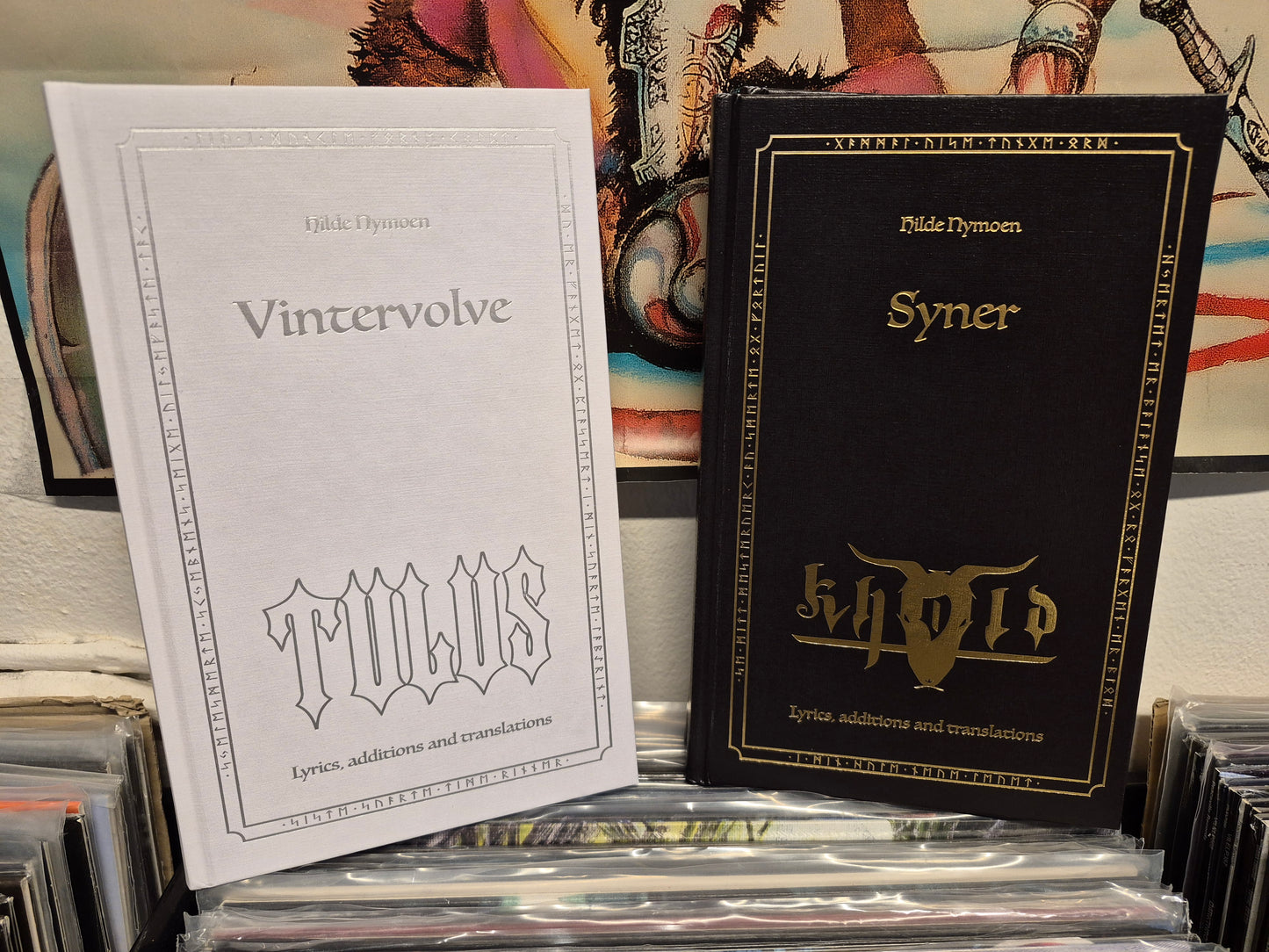
TULUS - Vintervolve BOOK
TULUS - Vintervolve BOOK
Couldn't load pickup availability
Taken from NEW NOISE MAGAZINE:
Lyricist Hilde “Hildr” Nymoen has established herself as one of the finest weapons in Black Metal, earning acclaim from the likes of Loudwire. In fact, MetalSucks has referred to her as the greatest woman in the art form. From the very beginning, this visionary and mystagogue has served as the poet behind the legendary Tulus, one of the very first True Norwegian Black Metal bands. This fearsome entity has always been helmed by Hildr’s husband, Blodstrup/Gard—in the early ’90s, he decided to co-found Tulus with Sarke, who became inspired to convert to the grimmest genre of them all after witnessing Darkthrone rehearse for A Blaze in the Northern Sky (1992). When the related outfit, Khold, emerged around 2000, there was no doubt that Hildr had to lend her brilliance to their endeavors as well.
Hildr’s work with Khold and Sarke’s eponymous project, which was fronted by Darkthrone’s Nocturno Culto, has earned her two nominations for Norway’s Grammy equivalent, Spellemann Awards. She definitely deserved to win above all friendly competitors, but the best pieces of art are rarely met with the full applause they are due at the time of their release. I long hoped that Hildr would celebrate her legacy with some form of book. Thus, the fact that she has chosen to unfurl two volumes of compiled lyrics, translations, and additions came as superb news. Vintervolve (“Winter Völva”) and Syner (“Visions”), which focus on Tulus and Khold, respectively, are absolute must-haves not just for black metal enthusiasts, but for anyone who enjoys poetry. These literary offerings, which generously deliver roughly 140 pages of content each, are simply phenomenal. Although we can clearly follow Hildr’s evolution herein, her sophistication and distinctive style unite her catalog.
Vintervolve and Syner arrive at the ideal time: it has been 30 years since Tulus unveiled their classic full-length debut, Pure Black Energy. Hildr was actually responsible for that record’s surprising cover image, which I have referred to as possibly the best in the movement. This year, Tulus premiered their eighth full-length masterpiece, Morbid Desires, which contains nods to their past, as the miraculous “Salme II,” a stellar tribute to one of their biggest influences, Black Sabbath, and even Tulus’ tour de force of a self-titled track. It feels as if the group are marking the completion of a circle on their spiral path; Vintervolve begins with “Tulus” and features its English translation at the end before proceeding to provide background info about the band and author. Hildr’s inclusion of “Tunge dråper fra et mørket hjerte” (“Weighty Drops from a Darkened Heart”), originally written in 1995 and expanded upon in 2025, too, demonstrates why it was worth waiting three decades for her collections.
The profoundly emotive, evocative, and psychologically unnerving writings within the two volumes in question have, of course, helped determine the essence, aesthetics, and subject matter of black metal. They also raised the bar, setting the gold standard and showing that refinement of pen would be necessary in the genre. Having grown up around the forests, Hildr linguistically paints Norwegian scenes and nature with entrancing and unforgettable effect, forever possessing audiences. Hildr moreover explores personal tragedies and the various manifestations of death and darkness, including plague and battle.
Her meticulously chosen Norwegian words, laced with rhymes, flow with otherworldly grace; even before Blodstrup’s masterful touch. (And yes, he is among the greatest vocalists in the genre.) They already contain much music. The elevated old Norwegian style that she employs optimally suits the content; Hildr necromances the spirit of bygone eras while crafting products that are timeless. Reading Vintervolve and Syner, it is absolutely clear that Hildr’s genius transcends labels. Much of her excellence lies in her ability to honor and expand upon her heritage, but, as already implied, her art is ultimately universal and bears rewards for all types of readers.
Hildr’s beautiful translations preserve the magic of her poems. They were executed artistically rather than literally, as proper translations should be in order to convey the writerly finesse present in the originals. Hence, they serve as stellar supplementary material for Norwegian speakers while illuminating Hildr’s creative universe for those who have yet to learn the language of so many greats. Granted, increased understanding only deepens the enigma emanating from Hildr’s texts, in which the symbolic and objective worlds seem to merge.
Both books boast nuggets of wisdom on the topics of mythology, folklore, and history, as they connect to the lyrics. Like Tulus, Khold has presented eight full-length albums. The most recent of these titles, 2024’s Du dømmes til Død, produced by Andy La Rocque, offers a special and rather epic treat: The nine songs tell different factual stories about executions in Norway, “from the first witch burnings in the 1500s up to the last public beheading in 1876.” Hildr’s informative descriptions of the historical events tackled are simply too fascinating. One of the poems in the Du dømmes til Død section relates to Hildr’s ancestor who served on a committee during a witch trial. (Hildr was only made aware of this story after the record’s completion; therefore, this gem became a 2026 addition.) Similarly, Tulus’ heartbreaking “Samuelsbrenna” from Fandens kall (2023), likewise produced by La Rocque, centers on another one of Hildr’s female forebears.
Vintervolve and Syner, which have been perfected down to the visuals, showcase magnificent pen and pencil sketches by Blodstrup, Hildr’s watercolor illustrations, and photos.
HARG FORLAG 2026